
Holiday generosity can get expensive fast. Between teacher gifts, family presents, toy drives, and the countless little obligations that pop up between Thanksgiving and Christmas, even the best intentions can leave your budget stretched thin. Before you know it, you’re spending money you hadn’t planned to spend, all in the name of giving.
But here’s something worth remembering: Teaching your kids to be generous doesn’t require you to spend more money. In fact, some of the most meaningful lessons in giving cost next to nothing.
A child who uses two dollars of their allowance to choose a can of soup for a food drive learns something different from a child who watches a parent drop fifty dollars into a donation box. One gets to experience the thought, the choice, and the satisfaction of helping someone else.
This holiday season, bring your kids into the giving process instead of handling it all yourself. With a little planning and a realistic budget, you can raise thoughtful, generous kids without putting your family’s finances under unnecessary strain.
Why Letting Kids Give Matters
Giving is a money skill. It belongs right next to saving and spending, not off in a separate box labeled “being nice.”
When a child sets aside even a small amount to give away, they run into a truth that shapes every money decision for the rest of their life: money is limited, and where you send it says something about what matters to you. That is a big idea wrapped in a small act. A kid does not need a large sum to feel it. They need to be the one making the call.
There is another reason to bring kids in, and the research backs it up. According to the Indiana University Lilly Family School of Philanthropy, children whose parents talk with them about charitable giving are 20 percent more likely to give to charity than children whose parents do not discuss giving with them. In other words, modeling generosity is good, but talking it through with your kids is what really moves the needle. The conversation is the lesson.
Giving can also be an especially rewarding money lesson. Saving often asks children to wait, and budgeting requires trade-offs. Giving lets them see the impact of a money decision right away.
And a note before we go further, because it matters. No family has unlimited resources, and giving should never create stress at home. A family that gives five dollars together can teach just as meaningful a lesson as a family that gives five hundred. Generosity is not a number. It is a habit, and habits do not have a minimum balance.
The “Give a Little” Framework
Here is a simple way to bring kids into holiday giving without reworking your whole budget. Pick a small, fixed giving amount, then let your child decide how to use it. That is the entire system. The size of the amount is up to you. The decision is up to them.
Kids can give in three ways, and all three count:
- Give money. A few dollars toward a cause they choose.
- Give time. Helping a neighbor, baking something for a shelter, writing cards for a nursing home.
- Give things. Sorting through toys, books, or clothes to donate.
The money route gets most of the attention, but time and things are just as real, and they are perfect for families keeping cash tight this season. A Saturday morning spent helping is generosity your child can see and remember.
The part that makes this stick is letting kids pick the cause. A child gives more happily, and learns more, when they care about where it goes. This is the same muscle they use when they sort needs from wants: they are weighing what matters most. Help them find the connection:
- Love animals? A shelter or rescue.
- Worried about other kids? A toy drive or children’s hospital.
- Care about food? A local pantry.
- Notice their own neighborhood? A community fund or a family nearby.
When the cause is theirs, the giving is theirs too.

Age by Age: How Kids Can Join In
Giving looks different at three than it does at sixteen. Here is where to start, depending on your child’s age. Pick the stage that fits, and feel free to borrow from the one just below it.
Ages 3 to 5. Keep it concrete and hands-on. Let your little one choose one toy in good shape to give to another child, or drop coins into a giving jar. They will not grasp the budgeting, and that is fine. What they are learning is that giving is a normal, happy part of how the family handles stuff and money.
Ages 6 to 8. Now you can introduce a small amount. Let your child set aside a dollar or two from their allowance or a chore, then choose where it goes. Talk through the choice out loud. This is the age where giving stops being abstract and starts being a decision they made.
Ages 9 to 11. Add comparison. Offer two causes and ask your child to pick one and explain why. That “why” is the whole lesson. You can also pull them into a real family giving decision, so they see that grown-ups weigh these choices too.
Ages 12 to 14. Bring in research and trade-offs. A tween can look up a cause, see how a donation is used, and budget a giving amount against their own money. This is also a great age to talk about giving time instead of cash, since their schedules and skills are growing.
Ages 15 to 18. Let teens run their own small giving project. That might mean organizing a collection, volunteering on their own, or deciding how to split their money across saving, spending, and giving. The goal here is independence. You are handing over the wheel while they are still close enough to ask for directions.
Make Gift Giving Part of the Lesson
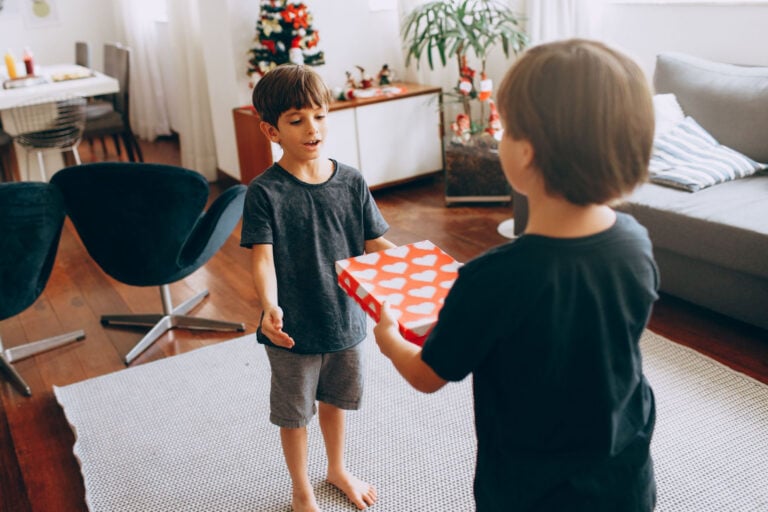
Let your child help choose a gift for a parent, grandparent, sibling, teacher, or friend. Talk about what that person likes, set a budget together, and let your child make the final choice. Then have them wrap and give the gift themselves. It turns holiday shopping into a lesson in thoughtfulness, budgeting, and giving.
Giving Without Blowing the Budget
Let us be honest about the pressure. December has a way of making every family feel like they should be doing more, spending more, and matching whatever the family down the street posted online. You do not have to.
A few ways to keep giving generous and affordable at the same time:
- Set the amount first, then give. Decide what your family can comfortably give before you pick a cause, not after. This keeps generosity from quietly turning into overspending.
- Make it one family amount, not a cost per kid. Pool a single giving amount everyone contributes to and decides on together. It turns giving into a shared project instead of another line item multiplied by the number of children in the house.
- Lean on time and things. When cash is tight, hours and hand-me-downs carry the same lesson. A family that shows up to help is modeling generosity just as clearly as one that writes a check.
- Skip the comparison game. Your giving should match your family’s means, not anyone else’s. A smaller gift given with intention teaches more than a larger one given out of guilt.

Here is a quick look at how giving can scale to fit any age and any budget:
| Age | Give Money | Give Time | Give Things |
|---|---|---|---|
| 3 to 5 | Coins in a giving jar | Help pack a donation box | Choose one toy to donate |
| 6 to 8 | A dollar or two from allowance | Bake or craft for someone | Sort books to give away |
| 9 to 11 | Pick between two causes | Help a neighbor or elder | Clean out and donate clothes |
| 12 to 14 | Budget a set amount | Volunteer a few hours | Organize a family donation |
| 15 to 18 | Split money across save, spend, give | Lead a volunteer effort | Run a small collection drive |
Make It a Habit, Not Just a Holiday
The warm feeling of December giving is real, but it fades fast once the decorations come down. The families who raise generous, money-smart kids are the ones who keep a little of it going all year.
You do not need a grand plan. A giving jar that stays on the counter after the holidays, a cause your child checks in on every few months, a spring afternoon spent volunteering: small things, repeated, are what turn a holiday activity into a lifelong habit. January is a natural time to carry the momentum forward, so if this clicks with your kids, keep the thread going into the new year.
Try This at Home
Before the holidays wrap up, run a five-minute giving exercise with your child. It works at the kitchen table or in a classroom.
Ask them three questions:
- Who do you want to help? Let them name a cause they actually care about.
- Why them? Have them say the reason out loud. This is the thinking part.
- What will you give? Money, time, or things. Pick one and make a plan to do it this week.
That is it. One cause, one reason, one action. You just walked your child through a complete giving decision, and they made every call themselves.
Frequently Asked Questions
How much should my child give? Less than you probably think. The amount matters far less than the habit. A dollar or two, chosen and handed over by your child, teaches more than a big gift they had no part in. Start with whatever fits your family’s budget comfortably, and let the lesson do the heavy lifting.
My kids do not get an allowance. Can they still take part? Absolutely. Giving time and giving things cost nothing. A child can help pack donation boxes, bake for a neighbor, or pick out toys and clothes to pass along. These count every bit as much as money, and for younger kids they often land harder because they can see the gift leave their hands.
What if my child wants to give to a cause I do not support? Start with a conversation. Ask why that cause matters to them, and share how your family thinks about choosing where money goes. You can set appropriate guardrails while still giving your child meaningful choices. The goal is a thoughtful giver, not a perfect one.
Is it worth it if they are too young to really understand? Yes. A three-year-old will not grasp budgeting, and they do not need to. What sticks at that age is the feeling that giving is a normal, happy part of how the family handles money. Understanding catches up later. The habit can start now.
The Takeaway
Kids do not learn generosity by watching money leave your account. They learn it by taking part, at whatever size fits your family. A few dollars, a donated toy, or a Saturday spent helping all teach the same thing: giving is a choice, and your child is old enough to make it.
Start small this season and keep it going, and you are not just checking a holiday box. You are raising an adult who knows that being generous and being smart with money are the same skill, not opposite ones.
Want to keep the save, spend, and give conversations going? My First Nest Egg has age-appropriate activities that help kids practice making real money decisions at home.
